

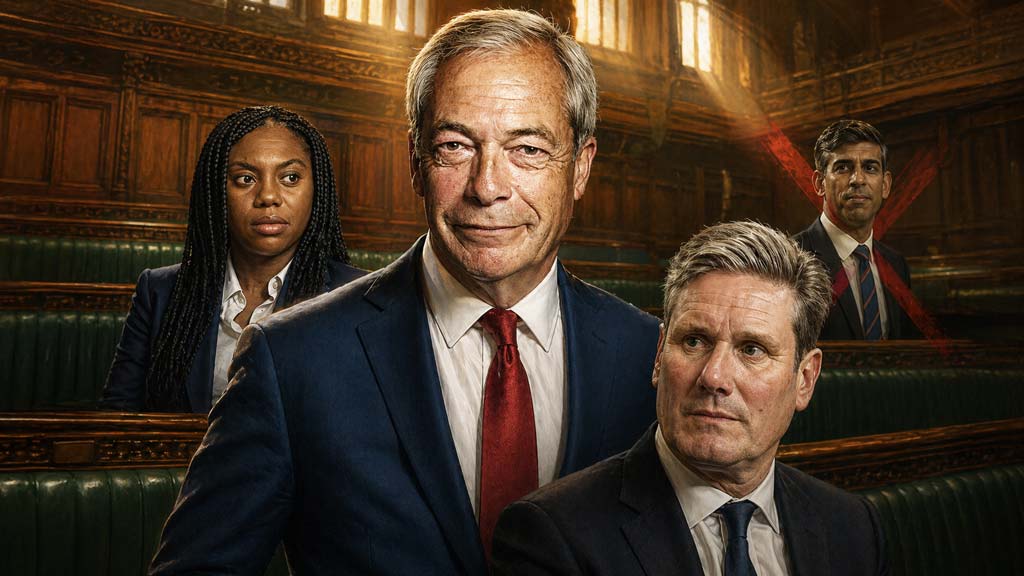

Reform UK won the 2024 election for Labour, and almost nobody noticed. The headlines screamed landslide. The Labour benches grinned. Sir Keir Starmer used the word generational. The country was told a victory had been delivered.
But the maths underneath was not telling the same story. Labour’s vote share was the lowest of any modern winning prime minister. Their advance in England was modest. In Wales, it actually fell. Something else moved the seats around the chessboard. It was not the words coming out of Sir Keir’s mouth.
This piece is about that other thing. It is about a quiet machine called first past the post. It is about a party with five seats that decided where 136 others would land. It is about what happens to a government that mistakes a structural fluke for a popular mandate.
Before we walk to 7 May 2026, we need to look honestly at what happened on 4 July 2024. Because the next ballot box does not care how loud the celebration was. It only cares whether you read the maths.
The Headline: A Labour Landslide and a Conservative Wipeout
On the night of 4 July 2024, the BBC’s exit poll told us where the country was heading. The numbers were ready before a single ballot was counted. Labour 411 seats. Conservatives down to 121. The biggest Labour majority since 1997. The biggest Conservative collapse in the party’s entire parliamentary history.
You have to walk back one hundred and forty-five years to find a leader who lost as many seats as Rishi Sunak lost that night, 236 gone. Disraeli lost 113 in 1880. Asquith was 114 in 1924. Major lost 178 in 1997. Churchill lost 187 in 1945, the year he had just won a world war. Balfour lost 211 in 1906. Henderson lost 215 in 1931, and only because half his party walked off with Ramsay MacDonald. Sunak sat past all of them.
The chart above puts it on a timeline so the eye can see the cliff. Names you may have heard of in school history lessons. None of them lost as many as Sunak.
The big names fell with the votes. Grant Shapps, the Defence Secretary, is gone. Penny Mordaunt, the Leader of the House and a Tory leadership contender, is gone. Gillian Keegan at Education is gone. Jacob Rees-Mogg, gone. Therese Coffey, gone. Johnny Mercer, gone. The Cabinet table emptied like a pub at last orders.
So far, this is the story everyone agreed on. Labour had won. The Conservatives had lost. The headlines were correct but incomplete.
The Reality Underneath: A Mile Wide and an Inch Deep
A landslide is a useful word for a newsroom. It is a less useful word for an analyst.
Labour did not win on votes. Labour won on geography.
Look first at the share. Labour took the country with 33.8% of the vote. That is the lowest winning vote share of any prime minister in the modern era. Five percentage points lower than what Jeremy Corbyn polled in 2019, and Corbyn lost. The arithmetic does not lie. A government built on one in three votes is built on a structural quirk. It is not a public embrace.
Look next at the geography. In England, where the great bulk of seats are fought, Labour’s vote share barely moved. In Wales, it actually fell. The whole story of a Labour surge collapses into a single country, Scotland, where the SNP’s collapse handed Labour a remarkable rebound. That part was real. Outside Scotland, the picture was of a country that had stopped voting Conservative, not one that had started voting Labour.
This is the bit that needs to be sat with. Labour was awarded 63% of the seats on 33.8% of the vote. The Liberal Democrats had won 72 seats on 12%. Reform UK had won 5 seats, taking more than 14%. The Greens had won 4 seats on 6% of the vote. The shape of it is not subtle. The two-party system is not what it used to be, but the seat allocation is still pretending it is.
I should declare myself here, because honesty makes for better storytelling. I am a Labour voter. I have abstained twice in five general elections. The system kept giving back the same thing in different colours. I voted Leave at Brexit. Not for the campaign slogans. I wanted to see the cliff edge for myself, not be told about it by loud men and women on either side. I am not on the fence about politics. I am on the fence about pretending the maths means something it does not.
How Reform UK Won the 2024 Election for Labour
This is where the maths walks out from behind the headlines.
The exit poll told us why the seats had moved before any of us understood it. The Conservative vote was not falling because Labour had become more attractive. It was falling because Reform UK sat in the way. They hoovered up Tory voters in the seats Conservatives most needed to defend.
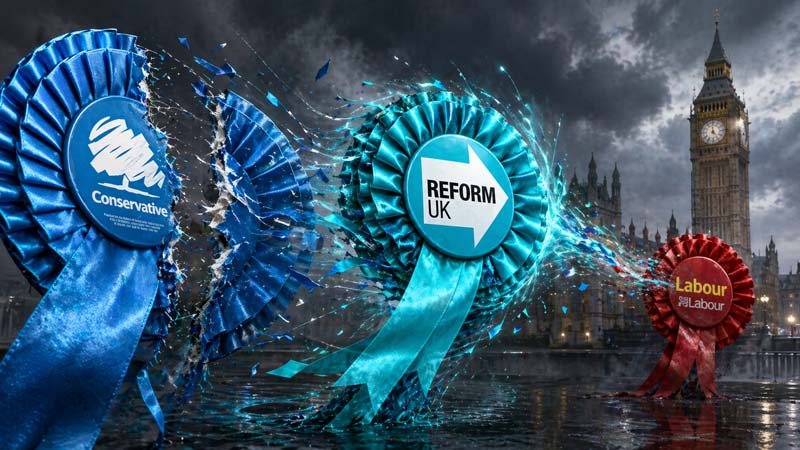
The finding was stark. Conservatives lost 244 seats. Reform polled more than the winning margin in 171 of them. That is not a small statistic. That is most of the seats they lost.
But headline statistics deserve interrogation. So, I built my own.
Using the official 2024 results from the House of Commons Library, I redistributed Reform UK’s votes. My transfer rates came from the British Election Study itself. 77.7% went back to the Conservatives. That share had voted Conservative in 2019 before defecting. Six point five per cent went back to Labour, the smaller share who had defected. The remaining 15% or so I modelled as non-voters. They were the older UKIP and Brexit Party bloc that turned out only for Reform.
I then asked the simple question. If Reform UK had not stood, who would have won each seat?
The answer arrived as 136. As shown in the chart above. One hundred and thirty-six seats flip back to the Conservatives under the Heath transfer model. One hundred and ten of those flips come from Labour. Sixteen come from the Liberal Democrats. The rest are scattered across Greens, Plaid, the SNP, and the 5 seats Reform itself won.
But the killer number is not the 136. It is the consequence of it.
Without Reform UK on the ballot, Labour ends up with 301 seats. The threshold for a Commons majority is 326. Labour falls 25 seats short. The country wakes up to a hung parliament instead of a landslide.
My independent reanalysis returned 176 of 252 for the benchmark check. Their published figure was 171 of 244. The numbers converge inside their own methodology. I am not contradicting peer-reviewed work. I am reproducing it.
That is the analytical bit. The human bit is harder to write.
Sir Keir Starmer entered Number Ten not because the country had backed him. He entered because Nigel Farage had stood in the way of his opponent. Strip Reform from the ballot, and Labour negotiates with the Liberal Democrats for the keys. The country we are governed by today is the result of a structural fluke.
Reform UK won the 2024 election for Labour, and the receipts are now public.
Who Reform UK’s Voters Actually Are and Where They Came From
Before I look at Labour’s collapse, we should meet the people who decided the result.
If you only read newspaper opinion columns, you would think Reform voters were one neat thing. They are not. They are a coalition, and the coalition has a clear shape.
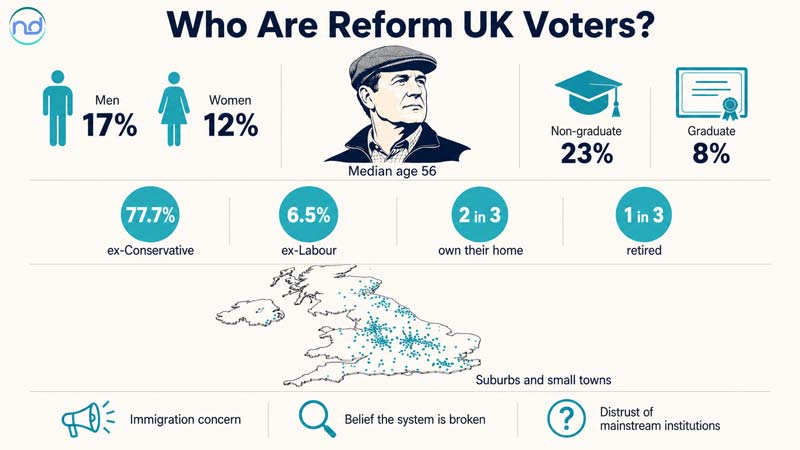
The clearest markers in the 2024 election were age, sex, education and Brexit identity. The median Reform voter was 56 years old. Men backed Reform by 17% to 12% more than women. The party did far better with non-graduate voters than with graduates.
GCSE-only voters backed Reform at 23%. Graduated at just 8%. It polled stronger in the working-class C2DE bracket (skilled, semi-skilled and unskilled manual workers, plus those on the lowest incomes) than in the middle-class ABC1 bracket (higher, intermediate and junior managerial, administrative and professional workers), by 20% to 11%.
Later support base work confirmed the same shape. Reform supporters today are still mostly white, mostly over 40, and mostly without a degree. Roughly two-thirds own their home. About one in three is retired. Many live in suburbs and small towns rather than in big cities.
What unites them is not one neat label. It is an attitude cluster. Worry about immigration. A pessimism that the country is getting worse. A distrust of politicians and mainstream institutions. A belief that the system is broken.
This is where the easy story breaks down for the people calling them all far right. Reform voters are culturally tougher than the public on immigration and race. That part is true. But several studies show they are not free market libertarians, and they are not US-style religious conservatives. They are more comfortable with redistribution than Conservatives are. They are more open to nationalisation. On abortion and same-sex marriage, they sit close to the wider public, not on the fringe.
Geography tells the same story. The hard Reform vote sits on the old Brexit populist map. Academic constituency analysis shows Reform did best in heavily pro-Leave, older, whiter, more working-class seats. Mostly, the party deepened support where UKIP had already been strong. It did not invent a brand new electorate.
Now, to where the votes came from. The strongest feeder by some distance is the Conservative Party, along with the older UKIP and Brexit Party blocs. It is not the Labour core. Among 2024 Reform voters who voted in 2019, 77.7% had voted Conservative. Only 6.5% had voted Labour. Roughly a quarter of Conservative voters who switched to Reform in 2024 had voted Conservative in 2019.
The story has not changed since the election. The British Election Study panel for May 2025 told the same story. Labour had lost only 8% of its 2024 voters to Reform. Forty-two per cent of Reform’s new supporters came from the Conservatives. Thirty-three per cent came from people who had not voted in 2024 at all. Only 16% came from Labour. More in Common’s separate 2025 study points the same way. The Labour to Reform stream exists, but it is smaller and driven by disappointment. The Conservative-to-Reform stream is larger and driven by migration.
Here is the bit the loud voices on Question Time miss. Calling these voters racist is both lazy and counterproductive. Some hold views I find ugly. Many do not. Most are people who feel unrepresented. For 15 years, the system has told them their concerns are not allowed in polite company. Concerns about housing, services, jobs, and the speed of change. Tell a chunk of your electorate to be quiet for long enough. Eventually, they find someone louder, and they vote for him.
The Arrogance That Followed and the Collapse in the Polls
There is a moment that a winning party always has. The opposition party has been cleared from the big chairs. The cameras are kind. The benches are full. The Prime Minister talks about generations, and journalists nod.
That moment lasted, in Sir Keir’s case, about six weeks.
The chart above tracks Sir Keir’s approval ratings as polled by Opinium. Notice the line marked Starmer becomes Prime Minister. Watch what happens to the red disapproval line right after it. By September, 24% of the public approved. Fifty-three per cent disapproved. The net was almost minus thirty.
That is not a normal start. The chart below puts it in perspective. After two months in office, Tony Blair’s net satisfaction had risen. Cameron and May had climbed into their thirties. Only the doomed leaders had dropped to where Starmer had landed. Liz Truss after the mini-budget. Boris Johnson after Partygate. Rishi Sunak in his polite descent. Starmer arrived in the office at plus seven. Two months later, he was at minus twenty-one. That is a Truss zone collapse without a mini budget to explain it.
The natural question is what caused it. YouGov asked exactly that question in September 2024, and the answers were not abstract. They were household.
Twenty-eight per cent of the disappointment came from the means-testing of Winter Fuel Payments. Sixteen per cent came from hitting pensioners and the poor. Together, that is 44% of all reasons given. Almost half of the public’s anger was about a single decision targeting older people on cold nights. The rest was scattered. Prioritising the wrong things. Not doing enough. Not keeping promises. Plus, the noise that follows any new government.
I want to come back to the arrogance bit, because it matters. After 4 July, Labour MPs gave interviews. They appeared on panel shows. Many of them spoke about the Conservatives in a particular way. Like a teenager speaking about a younger sibling who has just fallen down the stairs. Smug. Loud. Certain.
They told us, on camera, that the country had spoken. That the country had given them a once-in-a-generation mandate. The country had finally decided.
The country, of course, had decided no such thing. The country had ousted the Conservative Party from office. That is not the same sentence. And anybody who had spent five minutes with the maths could see the truth. The floor under Labour’s celebration was made of borrowed planks.
Once the Winter Fuel decision arrived, the borrowed planks gave way. The arrogance had told the public it was loved. The polls and the doorstep told a different story.
The 2025 Local Elections Made the Pattern Public
On 1 May 2025, the country tested Sir Keir’s first year of governing. Twenty-three councils held elections. Reform UK took 10 of them.
Ten councils. From a base of essentially zero. Durham in the north. Kent is in the south. Hundreds of new councillors. Mostly drawn from Conservative seats. Plus, Labour wards the party had held for decades.
UK
Democrat
The chart above is a snapshot. Reform of 677 councillors. Liberal Democrats up to 370. Conservatives down to 319. Labour cratering to 98. The story tells itself in shape, not just in numbers.
But the deeper view is the timeline. The chart below tracks councillor totals across all of British local government over 25 years. The blue line at the top is the Conservatives, the dominant party of local government for almost the entire period. Watch the line dip during the Boris Johnson and Liz Truss years. Watch it fall under Sunak.
Watch Labour climb to overtake. Watch Reform appear on the right-hand side. A turquoise line that did not exist a year earlier. From 22 seats in 2024 to 804 in 2025. A vertical leap that no other party has made in modern British political memory.
If those local results had translated into a UK-wide general election, the BBC’s projected share would have put Reform first, on 30%. Labour second on 20%. The Liberal Democrats are third with 17%. The Conservatives are fourth on 15%. The order of British politics, settled for a century, had been rearranged on a single Thursday.
The leaders’ actions on the Friday morning told their own story. Nigel Farage was hosting a firework display in Kent. Kemi Badenoch was writing in The Telegraph, calling it a bloodbath. Sir Keir was writing in The Times, telling the country he got it. He referenced the death of his late brother. He talked about feeling the same sharp edge of fury that voters had felt. He promised to crank up the pace.
That Friday post-mortem matters. Because the public is not interested in apologies. The public is interested in whether the next move is good or just the same move dressed differently. In the weeks that followed, Sir Keir picked the same move Rishi Sunak had tried in his final two weeks. It had not worked for Sunak. It would not work for Starmer.
Why Attacking Reform UK Is the Wrong Strategy
On 27 May 2025, Nigel Farage stood before a microphone and made a bold claim. Reform UK, he said, was now the party of working people. He talked about cutting billions in taxes. He talked about restoring the child benefit for families with three or more children. A policy that plenty of Labour MPs had called for from the back benches. The pollsters checked their numbers. Labour was now 8 points behind Reform on the gold standard tracker.
Two days later, the response arrived. Sir Keir Starmer stepped onto a stage and spent an entire event going after one man.
Could you trust him with your future? he asked. Could you trust him with your jobs, your mortgages, your pensions, your bills? He compared Mr Farage’s economic views to those of Liz Truss. He warned about unfunded splurges. He warned about Liz Truss all over again.
This is the moment a strategy started to die.
I want to take a sideways step here, because the pattern is older than this. Telling people not to do something rarely stops them from doing it. A parent sits a child down. They explain, very carefully, that under no circumstances should the child put their hand in the biscuit tin. The parent has, in effect, drawn a map for the child to the biscuit tin.
The same logic operates at an adult scale. Tell a country that voting Reform is dangerous, and the country starts to wonder why it is being told.
I voted Leave at Brexit. Not because the campaign slogans persuaded me. Not because of three hundred and fifty million pounds on a bus. I knew that figure was rubbish before I read it. I voted Leave for a different reason. Every authority figure on television had spent six months telling me what would happen if I did. Recession. Calamity. The collapse of trade. The walls are closing in. I wanted to see whether the cliff edge they kept pointing to actually existed. The same instinct lives in roughly half the country, and the political class has still not noticed.
Look at Europe if you want to see the rest of the script. France. Italy. Sweden. Denmark. Austria. Germany. The Netherlands. Pick any of them. The far-right party shows up. The mainstream calls it racist. The party shrugs. It files down its rough edges, hires better media advisors, and stops feeding the headlines.
Le Pen’s party in France did exactly this. Marine moved the messaging away from the antisemitism of her father’s era. The party is now described as nationalist rather than fascist. Whether you agree with the rebrand or not, the rebrand worked. In 2022, France held the second round of its presidential election. The far right was within touching distance of the Elysee.
The pattern is the same in the United States. People treated Donald Trump as a punchline in 2015. They are still adjusting to a country that elected him twice. The lesson is not that he was right. The lesson is that calling supporters of a movement stupid is a losing strategy.
Reform UK will follow the same path if it has any sense. The 2025 local election campaign suggests it does. The rough edges will get filed down. The candidates will get more polished. Economic policy will become more sophisticated. By the next election, the party will look professional, because professionalism is what scales a coalition.
And if Sir Keir keeps calling Mr Farage dangerous, he will be doing Reform’s selling for them.
The smarter move was always to sell the government’s own work. To answer Reform’s claims with better policies, not louder warnings. The Conservatives tried the same thing in the final two weeks of the 2024 campaign. It did not save Mr Sunak. It is not going to save Sir Keir either.
What 2024 Should Teach the Voter on 7 May 2026
On 7 May 2026, ballot boxes open across England for local elections.
The temptation, after a piece like this one, is to interpret it as a manifesto for one side. It is not. It is a manifesto for clear thinking.
Here is the single most important fact about British elections under first-past-the-post. Seats do not go to the most popular party. Seats go to whoever reads the local arithmetic.
In a thousand wards across the country on 7 May, that arithmetic will look different from the national headline. Where Reform is the challenger, the maths is one shape. Where Labour and the Liberal Democrats are competing for an anti-Conservative vote, it is another. Where the Greens have grown enough to win, like Gorton and Denton, it is a third.
If you take nothing else from this piece, take this. Look at your own ward. Find out who came first and second last time. Decide whether the party you would naturally vote for can win where you live. Decide whether your vote is doing what you actually want it to do.
That is how 2024 worked. That is how 2025 worked. That is how 7 May 2026 will work.
Sir Keir Starmer governs because Reform UK split the right-wing vote in the seats Labour needed to flip. Reform UK won the 2024 election for Labour in everything but the official press release. He did not lose, but he did not really win either. The country is not in love with Labour. The country was simply finished with the Conservatives. And the moment Labour decided to govern as if it had a popular mandate, the polls began to correct. That is what polls always do when arrogance arrives early.
The next ballot box does not care about what was said on the night of 4 July 2024. It only cares about what you do with your pencil on 7 May 2026.
Read the maths. Vote like an adult. Tell stories in numbers, not in slogans.
That is the only counterfactual any of us actually controls.
Sources
- BBC News. UK Election 2024 4 July 2024.
- Griffiths, J. D., Fieldhouse, E., Green, J. and Perrett, S. Looking for Labour’s Lost Voters. The British Election Study. 3 September 2025.
- Heath, O., Prosser, C., Southall, H. and Aucott, P. The 2024 General Election and the Rise of Reform UK. The Political Quarterly, Vol. 96, No. 1, January / March 2025.
- House of Commons Library. General Election 2024 Results. Research Briefing CBP-10009.
- More in Common and UK in a Changing Europe. From Protest to Power? Inside Reform UK’s Changing Support Base. September 2025.
- How Britain voted in the 2024 general election. 8 July 2024.