


‘Pain, loss, and powerlessness’ do not announce themselves.
Instead, they fill the room the way carbon monoxide does. Colourless. Odourless. Invisible to everyone standing on the outside.
On 22nd February 2026, Minnesota Vikings wide receiver Rondale Moore was found in his garage in New Albany, Indiana. He was just 25 years old. A second-round draft pick. 135 catches across three NFL seasons. 1,201 receiving yards. In other words, a young man with the world at his feet.
Yet hours before, he was with his family. Inside the house. Present. Smiling.
Then he walked into the garage and ended his life.
Soon after, the NFL released its statement. “We are deeply saddened.” The Players Association followed. “Please know that support is always within reach.” Talk to someone. Prioritise your mental health. Check on your teammates.
The same words. Every single time.
But Rondale Moore was not alone. After all, his family were right there in the same house. And still, nobody saw the carbon monoxide filling the room.
This was not isolated either. Less than four months earlier, on 6th November 2025, Dallas Cowboys defensive lineman Marshawn Kneeland also took his own life. He was 24. In fact, I had watched him score his first NFL touchdown just two days earlier. Two days. From a first touchdown to gone.
When I woke to the news of Moore’s passing, it hit me the way these things always do. Not as a headline. As a mirror. Because I know what it feels like when the room fills slowly. I have felt the air thinning myself. And I am still breathing through it.
So this post will not tell you to speak to someone, and everything will be fine. Because sometimes, it is not fine. Sometimes a person smiles at you, talks with you, and laughs with you. And yet, they are closer to the edge than you could ever see.
What follows is an honest attempt to name what most people miss. The silent build-up of ‘pain’, ‘loss’, and ‘powerlessness’ that works like carbon monoxide. It does not announce itself. It does not ask for permission. It fills the room until the person inside can no longer find the door.
You’re Fine Until You’re Not
Rondale Moore was described as humble. Soft-spoken. Respectful. Proud of his Indiana roots. His college coach at Purdue, Jeff Brohm, called him “the ultimate competitor” with a work ethic “unmatched by anyone.” A teammate who “always wanted to please everyone he came in contact with.”
That last line sits heavy now.
Moore won the Paul Hornung Award (given to the most versatile player in college football) as a freshman at Purdue. He was also a first-team All-American (a title reserved for the best college players in America). The Arizona Cardinals took him in the second round of the 2021 draft. He had speed, hands, and hunger.
Then the injuries came.
First, a knee injury with the Atlanta Falcons wiped out his entire 2024 season. So he joined the Minnesota Vikings for a fresh start. Then another knee injury in the preseason (exhibition games before the regular season) ended his 2025 season, too. Two full years of football, stolen.
Yet still, those around him spoke of resilience. Discipline. Dedication. His head coach, Kevin O’Connell, said Moore was “someone we came to know well and care about deeply.” The NFL praised his character. His former teammate JJ Watt said there was “so much left to give.”
And yet, nobody used the word struggling.
Because from the outside, there was nothing to see. The carbon monoxide had no colour. No smell. Moore was 25 years old. And then on a Saturday night, he walked from his family into his garage and shot himself.
That is what ‘pain, loss, and powerlessness’ look like from the outside. In fact, they look like nothing. They look like a quiet young man from Indiana who smiles, works hard, and never complains.
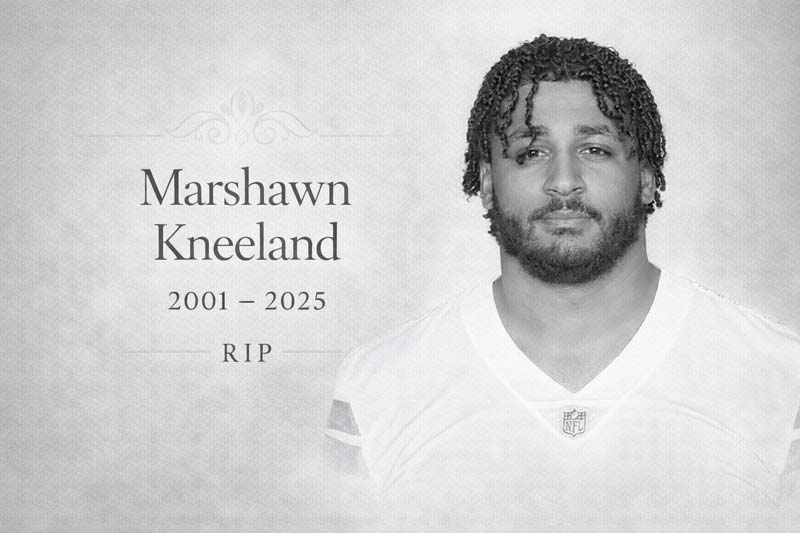
Marshawn Kneeland’s story carries the same silence, with one difference.
Like Moore, Kneeland was just 24. Also, a second-round pick in 2024, this time for the Dallas Cowboys. He played 18 games and started four. On 4th November 2025, he scored his first NFL touchdown, recovering a blocked punt against the Arizona Cardinals. A career highlight. A moment most players dream about for years.
Two days later, his girlfriend Catalina called the police. She told them he had his gun. She told them she was worried.
That phone call is worth sitting with. Because, unlike Moore, someone did see it. Indeed, someone did raise the alarm. Yet even then, it was not enough. After crashing his car, Kneeland fled on foot. Police launched a search. Still, he was found dead at 01:31 in the morning.
This is the part that people struggle with. The part that breaks the comfortable script.
We are told: talk to someone. We are told to check on our teammates. We are told: support is always within reach. And those words are not false. For many people, they work. Talking does save lives. The suicide rates confirm it. If nobody spoke, if nobody reached out, the numbers would be far worse.
But there is a gap in that message. A blind spot.
Because sometimes a person is not hiding their ‘pain’ from you. Sometimes, they do not even know how far gone the air in the room has become. The narrowing has already started. The future has stopped feeling real. Alternatives have stopped feeling available. And in that narrowing, endurance itself starts to look pointless.
I wrote in my diary the morning I heard about Moore:
You’re okay until you’re not, and you’re okay until the chemicals take over.
That word, ‘chemicals’, is my shorthand for something deeper than a simple switch. It is not that a person wakes up one morning and decides to end their life out of the blue. Rather, it is the slow, invisible accumulation. ‘Pain’ wounds. ‘Loss’ hollows. And when the weight of both meets the wall of ‘powerlessness’, the exits close. The room fills. The person inside can no longer think past the next breath.
But from the outside, they were fine.
What ‘Move On’ Will Never Fix
People love to say it. Move on. Let it go. Start fresh. Find someone new. Time heals.
Indeed, I have heard every version. From family. From friends. Even from strangers who know nothing about what sits inside me. And I understand why they say it. After all, it comes from a good place. Most of the time, it comes wrapped in love.
But it comes from the outside. And from the outside, people see behaviour. They do not feel totality.
Yet my suffering did not begin with a bad day. It began with a pattern of infidelity that started in the UK and followed us to Qatar. Then came the denial of what was happening, even when the evidence was clear. And it ended with me being told to leave the country I had moved to for my family.
At the time, I had no residency of my own. So when it fell apart, I returned to the UK. Alone. With nothing but my tail tucked in between my legs in shame.
Then, behind my back, a divorce was processed through a system designed to sidestep UK jurisdiction. No separation period. No mutual consent. No process that any British family court would recognise. Just a clean legal cut in a country where contacts make the impossible possible.
I was told by a UK lawyer that I would win if I challenged it. The cost? £60,000. Of course, she knew I did not have it. And that was the leverage.
So the children stayed with her. Three of them. My youngest was four when I left. He is now eight. My daughter was seven. She is eleven. My eldest was nine. He is fourteen.
Five years of their lives. Five years of growth, change, and shaping that I was not part of.
And this is where the word ‘loss’ stops being abstract.
Because I did not lose a marriage. Marriages end. People recover. What I lost was the ability to raise my children. To instil values. To shape three human beings into people who give something real to this world. That is not a loss you move on from. It is a loss that moves with you. Every single day.
This is what ‘pain, loss, and powerlessness’ look like when they are not statistics. When they are not headlines. When they live in your chest and wake up with you.
And then comes the ‘powerlessness’.
I cannot correct what was done through the courts. Simply, I do not have the means. So I have spent three years building something else. A platform. A public record. Not for revenge, but for truth. Because the worst part of this is not just the ‘pain’ or the ‘loss’. It is the slow alienation of my children from the person I actually am.
The lies that reshape how they see their father. The story that says I left. That I chose this. That I am the kind of man who walks away.
A black father who left his mixed-race children. Every lazy stereotype confirmed in one false story.
I am not that man.
Instead, I am a man who was too self-conscious about his dyslexia to date until he was 21. A man who lost his virginity at 22. A man who kissed six women in his life. A man who never drank alcohol, never smoked, never touched drugs. A man who wanted children from the age of 18. Not to fill a box. Not to look right from the outside. But to suffer with them as they grew. To walk beside them. To make them good humans who contribute something meaningful.
That is who I am. And that is who is being erased.
My deepest suffering is not ‘pain’ alone. Rather, it is dispossession. Of my children. My role. My voice. My authorship of the truth.
When people say “move on,” they are speaking from a world that is still open. They can see options. They can see a future. But from inside the room where the carbon monoxide has been building for five years, the air is different. The future does not feel like somewhere I am heading. Instead, it feels like something happening to other people.
So I cope. I run. I train. I do yoga, meditation, HIIT (high-intensity interval training), and I walk for hours each day. But these are not hobbies. They are the things that keep me breathing. Because without alcohol or drugs or any of the usual ways people numb the weight, ‘pain’ sits with you raw. Undiluted. You meet it every morning, and still, it does not flinch.
Yet I function. I build. I write. I create.
From the outside, I am fine.
Pain, Loss, and Powerlessness: The Room That Fills Slowly
When I first started writing about what I was feeling, I called it ‘pain and hurt’.
It felt right at the time. Both words carry weight. Both words land. But as I sat with them longer, I realised they were repeating the same thing. ‘Hurt’ is really a subset of ‘pain’. The pair has emotional force. Philosophically, though, it is narrow. Almost repetitive.
So I moved to ‘pain and helplessness’.
This was closer. Because ‘pain’ by itself does not always destroy a person. Humans endure extraordinary amounts of it. What begins to break a person is ‘pain’ with no agency (no ability to act or change the situation). No way out. No control. No meaning attached to the suffering.
That distinction matters. ‘Pain’ alone is survivable. ‘Pain’ without agency starts to corrode.
But even that was not the full picture.
In the weeks after Rondale Moore’s passing, I sat with my own weight. I tried to understand what pushes a person past the point of return. And slowly, the framework sharpened.
I arrived at ‘pain, loss, and isolation’:
- ‘Pain’ = wounds
- ‘Loss’ = empties
- ‘Isolation’ = seals it in
Three forces. Each one is distinct. Together, they form the architecture of human anguish. ‘Pain’ opens the wound. ‘Loss’ hollows a person from the inside. And ‘isolation’ locks it all in, with no exit and no witness.
That felt close. But something still was not right.
Because when I held the framework against my own life, ‘isolation’ did not sit where I expected. I love solitude. I have chosen it. It nourishes me. The silence, the walking, the hours alone with my own mind. That is not what destroys.
So I had to split the word:
- Solitude = chosen, and sometimes the only thing that keeps you sane
- Isolation = being left alone with a burden no one else can carry
They look the same from the outside. From the inside, they are entirely different rooms.
And that is when ‘pain, loss, and powerlessness’ landed.
Not ‘isolation’. ‘Powerlessness’.
Because ‘isolation’ often follows. But ‘powerlessness’ is what closes the exits. It is the difference between a wound that heals and a wound that cannot be healed.
‘Pain’ hurts.
‘Loss’ hollows.
But what makes suffering truly destructive is the inability to alter what has happened.
That is ‘powerlessness’. And that is the part that tips a person over the edge.
In my case, the injury is not ordinary heartbreak. It is the theft of fatherhood, joined to betrayal, joined to the complete inability to put it right. This is why the “move on” offered from the outside sounds not just hollow, but foolish. It assumes the thing lost was replaceable. Some things are not. A father does not swap children for a new life and call it healing. That is not wisdom. That is moral laziness dressed as advice.
And this is where the carbon monoxide comparison fully crystallises.
‘Pain, loss, and powerlessness’ are like carbon monoxide. They silently accumulate inside a person. Perception narrows. And escape is mistaken for a solution.
That sentence sits at the heart of everything written here.
A person can smile, function, speak normally, train, create, and build. And still be closer to the edge than anyone around them sees. Surface behaviour is not proof of inner safety. It never has been.
Most people do not grasp the weight. Not because they are evil. Not because they lack compassion. But because suffering is radically private. You can recognise symptoms from the outside. You cannot inhabit the weight.
That gap matters:
- A person on the outside sees behaviour.
- A person on the inside feels totality.
“Cheer up.” “Stay strong.” “Give it time.” “Talk to someone.”
These are words offered from a world that still feels open. The people saying them can still see a horizon. Their future still has shape. But for the person carrying ‘pain, loss, and powerlessness’, the world has already narrowed. The future has lost its form. Options have disappeared. And keeping going has started to feel meaningless.
In that narrowing, death is not chosen as destruction. It is mis-seen as release.
This is what most people misunderstand about suicide. It is not that the person wanted to die. It is that living had become so heavy that the mind could no longer see past it.
There is a difference between suffering that visits and suffering that stays. When ‘pain’ is episodic (comes and goes), you ride it out. When ‘loss’ is contained, you grieve and, in time, rebuild. But when suffering becomes atmospheric (when it stops being one experience among many and becomes the air itself), everything changes.
Once suffering turns atmospheric, ordinary language fails. None of the familiar phrases names the thing properly. And none of them reaches inside the room where the carbon monoxide has already changed the air.
Many people carry ‘pain’ and ‘loss’ without collapsing. That is important to say. Suffering does not always become lethal. But it does when the mind arrives at one quiet conclusion:
What matters most has been taken, cannot be restored, and no one can truly repair it.
That is the centre of it all.

They Do Not Know
The central truth is not that people do not care.
It is that they do not know.
Not because they refuse to look. But because knowing would require carrying the weight from the inside. And most people have never had their world reorganised by suffering.
They have felt sadness. They have felt disappointment. And they have felt grief that, in time, softened. But they have not felt the kind of ‘pain, loss, and powerlessness’ that changes the air in the room. The kind that does not soften. The kind that sits with you at breakfast and follows you to bed.
Until suffering reorganises your own world, you will speak from the outside. You will say the right things. You will mean them. And you will still not know.
Rondale Moore’s teammates did not know. Nor did Marshawn Kneeland’s coaches. The people closest to them saw behaviour. Yet they did not feel totality.
And that is not their fault. Because it is the nature of carbon monoxide. You cannot see it. You cannot smell it. You do not know it is in the room until someone stops breathing.
So the question that remains is not whether we should talk to each other. We should. Nor is it whether help matters. It does.
The question is this:
Is the real human problem that suffering is invisible? Or that most people lack the imagination to take invisible suffering seriously?
I do not have the answer. But I believe the question matters.
Rest in peace, Rondale Moore.
Rest in peace, Marshawn Kneeland.