

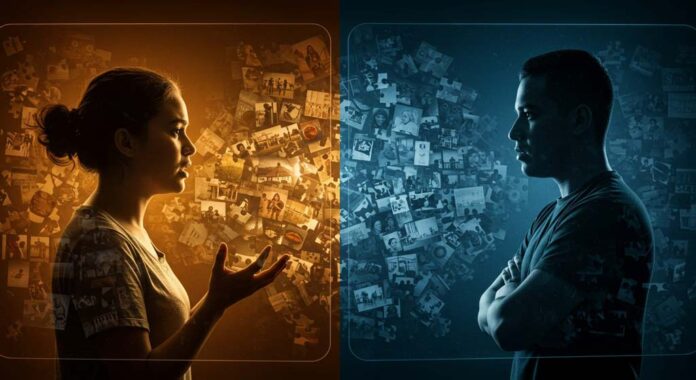

Why people struggle to understand others became crystal clear to me when my sister’s friend decided she knew exactly how I should handle my life.
After years of withdrawing from society to protect myself and find my own voice, this lady waltzed in with her opinions about my “wrong” approach to dealing with having my children stripped away through legal manipulation.
Everyone, it seems, believes they know how you should feel, how you should be, or how you should handle your unique circumstances.
The trigger moment made me sit back and think. Here I was, someone who looks in the mirror consistently, even before my current struggles, being told by someone else that I was doing life incorrectly. It’s fascinating how people often fail to realise that their approach to situations can be completely irrelevant to someone else’s reality.
What I realised is that people project their feelings, their trauma, their failures, their successes, and their coping mechanisms onto others. Whether it’s childhood experiences or recent struggles, they’re essentially trying to fit you into their existing framework rather than actually understanding your situation.
On the surface, three obvious things stop people from being more understanding:
- Ego – people get stuck in their own heads and views, refusing to let go of being right
- Lack of exposure – if you don’t see different perspectives, you can’t understand them
- Time and effort – understanding requires work and patience that many can’t be bothered with
However, there’s something much deeper happening here. Something rooted in human psychology and our evolutionary wiring that goes far beyond these surface barriers. When you start pulling apart why people genuinely struggle with understanding others, you uncover patterns that explain everything from fractured relationships to global conflicts.
The insights below will show you the fundamental psychological drivers behind these failures, how our modern world amplifies ancient instincts, and what happens when entire societies lose the ability to truly hear each other.
The Real Reasons Why People Struggle to Understand Others
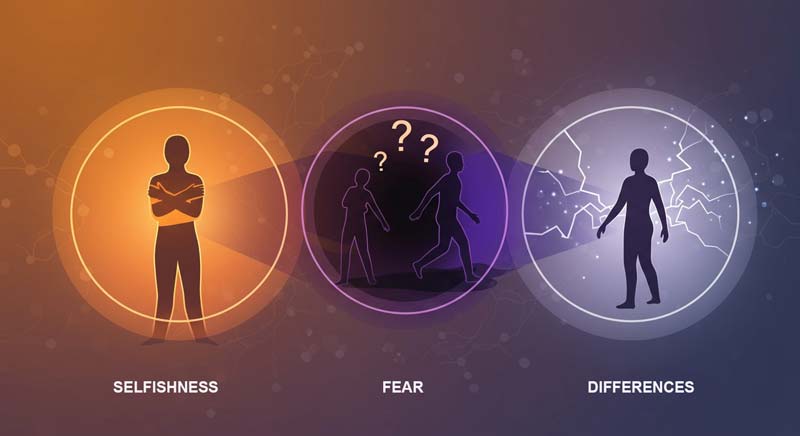
When you dig beneath the surface explanations, why people struggle to understand others becomes a story about three fundamental psychological forces that shape every human interaction.
Most breakdowns aren’t actually about disagreements or different opinions. They’re about something far more primal: defence of identity. After much pondering and reflection on my sister’s friend’s words, I’ve identified three barriers that are really just wrappers for a deeper driver controlling almost everything we do.
- Selfishness: The Survival Instinct
Selfishness isn’t just about being self-centred. It’s a human instinct to prioritise our own interests. This survival mechanism often leads us to prioritise our own views over truly listening to others. When someone challenges our perspective, our brain treats it as a potential threat to our sense of self.
This explains why people struggle to understand others even in personal situations. Your own worldview feels safer than exploring someone else’s reality. It takes less mental energy to defend what you already believe than to genuinely consider that you might be wrong.
- Fear: The Emotional Barrier
Fear runs much deeper than simple nervousness. People fear what they don’t know or what challenges their established worldview. That fear stops them from opening up to different perspectives. It’s the fear of the unknown, which is a fundamental human condition that kept our ancestors alive.
When someone shares an experience that doesn’t fit your existing categories, your brain has to work harder. It’s psychologically risky to explore new viewpoints because it might require changing how you see yourself or the world.
- Differences: The Cognitive Challenge
Differences represent the difficulty humans have in seeing common ground when people aren’t like them. Our brains are naturally lazy and prefer patterns they’ve already learned. It takes genuine effort and intellectual humility to appreciate viewpoints that don’t match our existing mental models.
This is why respecting others’ paths becomes so challenging when their journey doesn’t mirror our own. We assume our way of handling things should be everyone’s way.
These three forces – selfishness, fear, and differences – serve the same master: self-preservation. People resist understanding others because it costs them something: time, energy, vulnerability, maybe even status.
When Self-Preservation Becomes the Enemy of Connection
The fundamental insight hit me when I realised that why people struggle to understand others isn’t about surface-level personality flaws. It’s about fundamental self-preservation instincts that once kept humans alive but now destroy our connections.
From an evolutionary perspective, these barriers are hardwired into us. Humans evolved to protect their in-groups, to be wary of the unfamiliar because it could be dangerous, and to stick to familiar patterns because that’s energy efficient. We’re basically programmed by evolution to be self-protective and cautious.
Selfishness = Preserving Personal Resources and Status
When my sister’s friend criticised how I handle my situation, she wasn’t really concerned about my well-being. I don’t pick up calls or respond to text messages anymore; I’ve completely withdrawn from people’s attempts to “fix” me.
She was defending her own approach to life. Admitting that my way might be valid would threaten her identity as someone who “handles things correctly.”
This connects directly to how power dynamics work in relationships. People use their supposed understanding as a way to maintain superiority over others who are struggling.
Fear = Preserving Psychological Safety
Fear isn’t just about avoiding the unknown. It’s about avoiding anything that might force us to question our fundamental assumptions about reality. When certainty becomes more critical than connection, fear destroys what matters most.
This explains why even close friends and family can fail to truly hear you. They’re not just listening to your words; they’re filtering everything through their need to maintain psychological comfort.
Differences = Preserving Familiar Categories
Our brains resist integrating new information that doesn’t fit existing patterns. It’s easier to dismiss someone’s experience as “wrong” than to expand our understanding of what’s possible. The journey from uninformed to awakened requires genuine effort that most people simply won’t invest.
This preservation instinct explains the complexity of conversations when friends don’t actually hear you. They’re not trying to understand your reality; they’re trying to fit you into their existing framework.
The tragedy is that self-preservation, which once protected us, now isolates us from the very connections that could enrich our lives.
Why People Struggle to Understand Others in Our Modern World
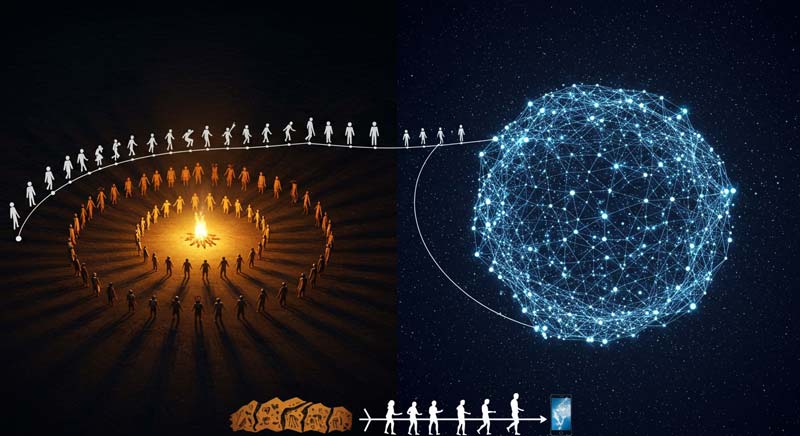
Historically, understanding was enforced by necessity in pre-industrial societies. Small, relatively homogenous communities meant you had to get along with your neighbours because you were directly interdependent.
Why people struggle to understand others has been amplified dramatically by how our world has evolved.
The Industrial Revolution changed everything. Societies became bigger, more urban, and more diverse. People started forming identity groups beyond their village or family. That’s where modern polarisation began: class divides, ideological movements, and the early fractures we see today.
Digital Echo Chambers
Now we live in a high-tech, AI-driven world (my personal favourites being ChatGPT and Anthropic’s Claude; yes, I’m part of this very problem) with even more complexity. People can form global tribes online, and the sheer volume of information means we can all exist in our own echo chambers. Instead of small villages, we have digital communities. Instead of local fears, we have global ones.
This technological amplification explains why people struggle to understand others more than ever before. The transformation of power in modern society has weakened traditional authority structures that once encouraged cooperation.
Amplified Ancient Instincts
We’ve essentially layered modern technology and global politics on top of old human instincts. The same psychology that worked in villages of 150 people (the cognitive limit of stable social relationships humans can maintain, which modern companies use to structure teams) now operates across networks of millions. That’s why these divisions feel so pronounced today.
Modern politics and global power dynamics amplify those ancient self-preservation instincts. The result is that we fragment society in new but familiar ways. We still operate from selfishness, fear, and resistance to differences. Still, now these barriers can separate us from people we’ll never even meet.
Social media algorithms specifically exploit these psychological vulnerabilities. They present us with content that reinforces our existing beliefs while omitting challenging perspectives. This creates artificial certainty about complex issues, making genuine understanding nearly impossible.
The irony is that we have more tools for connection than ever before, yet we’re more divided than previous generations. Technology promised to bring us together, but instead gave us sophisticated ways to avoid the discomfort of truly understanding different viewpoints.

The Cost of Staying in Our Own Heads
When we fail to push past these barriers, the consequences ripple through every aspect of human society. Why people struggle to understand others isn’t just an individual problem; it creates systemic failures that affect everyone.
The cost of not becoming more understanding creates a more divided world. These aren’t theoretical problems but real consequences that shape daily life for billions of people.
Personal and Relationship Costs:
- Division in Relationships – More conflicts and misunderstandings because people stay in their own corners
- Emotional Isolation – People feel lonelier because a genuine connection requires understanding and empathy
- Missed Learning Opportunities – You lose out on new perspectives and personal growth
- Reduced Trust – A lack of understanding erodes trust, making it harder to build cooperative bonds
Social and Professional Costs:
- Lack of Collaboration – Teams and communities struggle to work together, meaning fewer innovative ideas
- Poor Problem-Solving – Diverse viewpoints help solve problems, so solutions become narrower and less creative
- Increased Prejudice – People remain stuck in their biases, leading to more stereotyping and discrimination
- Stagnation – Without understanding, people and groups don’t grow or adapt
Societal Costs:
- Increased Conflict – Misunderstandings escalate into bigger disputes in families, workplaces, and societies
- Reduced Empathy – The less you practise understanding, the harder it becomes to empathise.
This isn’t about being some kind of saint or guru (I am happy being a nobody). It’s about recognising that everyone’s got their own stuff going on, and we’re all wired differently. The difference between sadness and depression shows how one-size-fits-all solutions fail when applied to individual human experiences.
If we could push past our knee-jerk reactions and listen more, we’d have fewer fractures and more genuine conversations. Everyone’s got their own battles, and a little understanding goes a long way. You don’t see their pain or worries, just like they can’t see yours.
The tragedy is that these costs compound over time. Each failure to understand creates more distance, more mistrust, and more certainty that “those people” are fundamentally different from us. What starts as individual self-preservation becomes collective isolation.
Goed artikel.
Ik zocht info t.a.v mijn dochter met Down, zij woont nu in een instelling, 24 jaar.
Ik zocht iets over begrip en samenwerking
Heb het idee dat een mens met Down die iets makkelijker in de omgang is, zich maar moet aanpassen( teveel) . Ik kon wel iets met dit artikel, dank
Dutch Reply:
Dank je wel dat je de tijd hebt genomen om mijn artikel te lezen én om zo open te delen wat er speelt. Dat waardeer ik echt.
Ik schrijf dit soort stukken vaak als een verlengstuk van mijn eigen hoofd en hart. Ik probeer woorden te geven aan wat ik voel, juist omdat het me helpt om het voor mezelf beter te begrijpen. Soms is het pas echt helder als het eenmaal op papier staat.
Daarom raakt het me extra dat het jou iets heeft gebracht. Als het ook maar een klein stukje begrip heeft losgemaakt, of je even het gevoel gaf: ik ben niet gek, ik ben niet alleen, dit is ingewikkeld, dan heeft het artikel gedaan wat ik hoop dat het doet.
Dank je wel voor het delen van jouw ervaring. Ik wens jou en je dochter oprecht meer begrip, samenwerking en zachtheid toe in de mensen om jullie heen.
Nogmaals: bedankt voor het lezen en voor je reactie.
Paul
English Reply:
Thank you for taking the time to read my article and for sharing so openly what is going on. I genuinely appreciate it.
I often write pieces like this as an extension of my own mind and heart. Putting feelings into words helps me understand them more clearly. Sometimes it only becomes real clarity once it is on the page.
That is why it moves me even more to hear it meant something to you. If it unlocked even a small piece of understanding, or made you feel, even briefly: I am not crazy, I am not alone, this is complicated, then the article has done what I hope it can do.
Thank you for sharing your experience. I truly wish you and your daughter more understanding, cooperation, and gentleness from the people around you.
Again: thank you for reading and for commenting.
Paul