

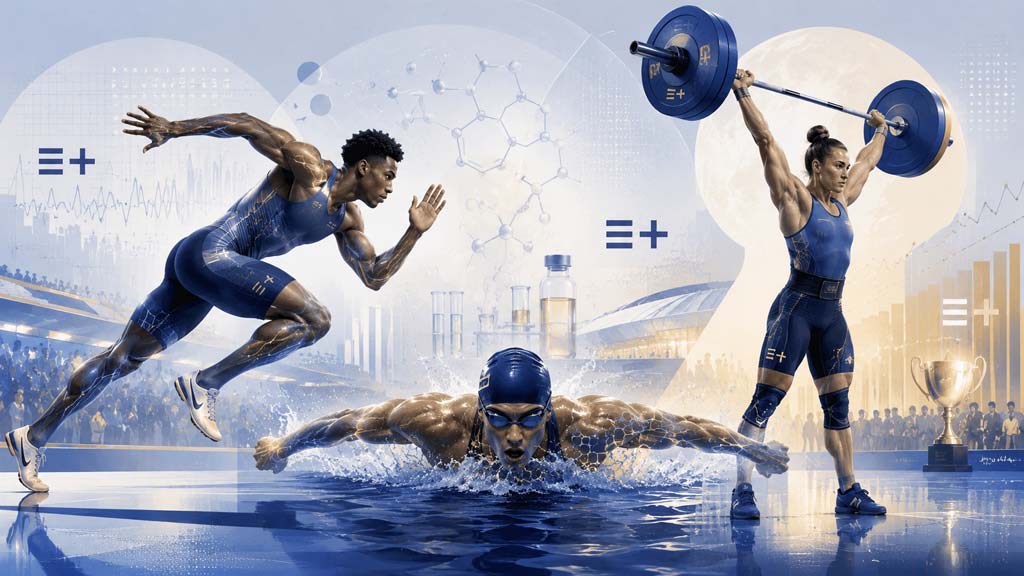

The Enhanced Games is not really a sporting event. It is a mirror, and sport does not enjoy its own reflection.
You should know who is holding that mirror up to you. I competed for most of my life, first in football and later in athletics. I chased a world title and an Olympic final. Neither arrived.
Here is the detail that shapes everything below. Across every season, I put nothing artificial into my body. No creatine, no protein shakes, not even caffeine. I drank isotonic fluid to replace my own sweat, and stopped there. I was that strict because I feared what a shortcut might cost me at fifty.
So I hold no warmth for drugs in sport. I watched gifted friends lose to rivals who were quietly chemical and never caught. Some of those friends left the sport broke and bruised. That memory sits behind every line here.
And yet a lazy verdict would insult you. This Enhanced Games contest is a different animal, rewarding slow thinking over fast outrage. Some of what its critics say is plainly true. Some of it is fear masquerading as concern. Separating the two is the real work.
So I will not hand you a tidy opinion to swallow. I will lay out the money, the science, the history and the people, then reason through them in plain sight. And near the end, a worry arises that has nothing to do with Las Vegas. It sits far closer to home.
So, What Exactly Are the Enhanced Games?
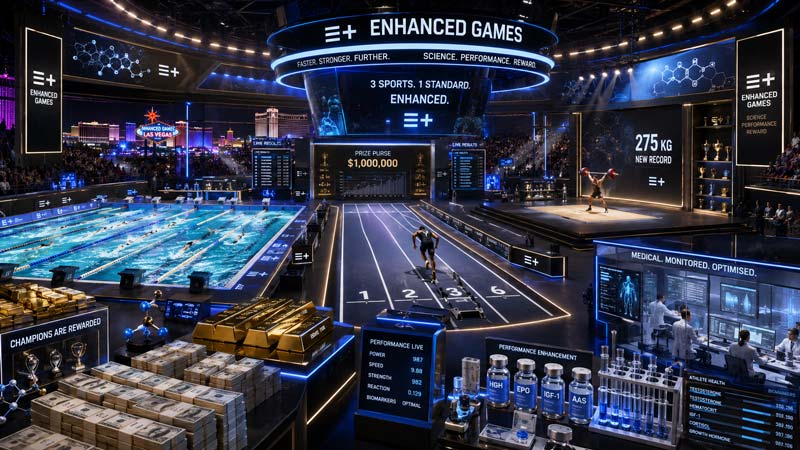
A temporary arena is rising on the Las Vegas strip. Four lanes of pool, a short sprint track, a weightlifting platform. The first event runs over four days in May 2026.
Three sports feature, and the choice is not innocent. Swimming, sprinting and weightlifting are power events. They reward raw force and explosive speed. They are also the events where the drugs on offer pay their biggest dividend. A shrewd organiser picks the ground where the experiment will show best.
Around forty athletes signed up. Before competing, they spent months at a five-star resort in Abu Dhabi. Training was free, food was free, and so were the drugs.
The money on the table
This is where the Enhanced Games stops resembling sport and starts resembling a business. Win an event, and you collect $250,000. Break a world record, and a single $1m bonus follows. The full prize pot stands at $25m.
The drugs, and a word about that approval
Organisers repeat one reassuring line. Every substance is approved by the FDA, the United States Food and Drug Administration. That body licenses medicines, so the claim sounds solid. Yet the small print of that comfort. These drugs were licensed to treat sick people whose bodies lack something. They were never licensed to push a healthy body beyond its limits. Approval and safety are not the same word.
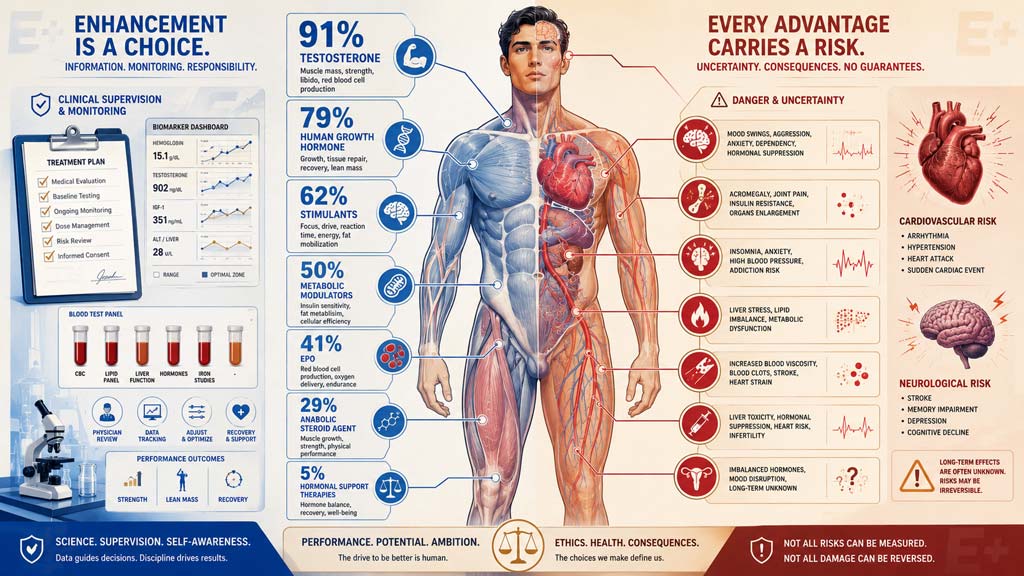
Here is what the athletes actually used, by the organisers’ own figures:
- 91% used testosterone, the main male sex hormone
- 79% used human growth hormone, which builds muscle and tissue
- 62% used stimulants, which sharpen the brain and nervous system
- 50% used metabolic modulators, which alter how the body makes energy
- 41% used EPO, or erythropoietin, which raises oxygen-carrying red blood cells
- 29% used an anabolic steroid agent, a muscle-building drug
- 5% used hormonal support therapies
Taken as a whole, that list is not nervous dabbling at the edges. It is a layered, serious chemical programme, designed and stacked by doctors.
One fact still cuts against the grain. Four of the athletes are competing completely drug-free. The Enhanced Games forces a needle on nobody, at least on paper.
The project has already taken a scalp. A Greek swimmer, Kristian Gkolomeev, beat a record that had stood since 2009. He managed it with drugs and a banned suit. A swimmer competing clean has since gone quicker still.
Everyone in This Story Wants Something
There is no neutral voice in this story. Every person talking about this contest is also selling something. Once you see what each one is selling, the noise begins to make sense.
The organisers
They speak about human potential. The reality is plainer. They are building a business, and they say so without blushing. The plan is to sell testosterone, supplements and longevity products to the public. The competition is the shop window. The athletes are the live demonstration.
There is a tell in how the organisers behave. They insist they occupy a separate lane, doing their own thing. Yet they sued World Aquatics and anti-doping bodies for $800m, because those bodies banned anyone who takes part. A New York judge threw the case out. You cannot call yourself a separate world, then sue the old one for guarding its own door.
The sponsors
A new event built on banned drugs is poison for most brands. So the backers it attracts are a particular type. They are companies and investors who do not care what mainstream opinion thinks. For them, attention is the prize, and any headline counts as a win. The tech billionaire Peter Thiel is involved. So is a venture fund tied to Donald Trump Jr.
The Olympic movement
It wants this gone, and the reason is honest enough once named. The Olympics sells a clean, natural ceiling on what a body can do. A rival waving needles threatens that idea, and the fortune resting on it.
The governing bodies
The volume of complaints is not even. Athletics and swimming have been furious. Weightlifting has stayed oddly quiet. That gap is not an accident. Athletics and swimming sell purity, the clean hero, the natural record. Strength sport never quite could. Bodybuilding has lived openly with these drugs for decades. So the volume of outrage closely tracks one thing. It tracks how much clean image a sport still has left to protect.
The testing authorities
Anti-doping bodies exist to catch cheats. If drugs were ever waved through, those bodies would lose their purpose and their funding. So, of course, they call this dangerous. Their survival depends on that verdict.
Yet here they have missed something, and it frustrates me. The Enhanced Games is handing science a gift it may never see again. Many of these athletes remained clean throughout their careers. Now they dope openly, measured and monitored. Anti-doping could have quietly asked for that before-and-after data. They could have learned how a real body changes under these drugs. Instead, they reached for the megaphone.
I am not asking you to choose a camp; I am only asking you to hear every angle at once. So I have gathered the loudest voices into the illustration below. It runs from the Enhanced Games organisers to the people who want them buried. The distance between them is the real story.
The Enhanced Games Debate: In Their Own Words
A side-by-side look at the five camps shaping the Enhanced Games story: the organisers, the athletes, the sporting establishment, the anti-doping authorities and the independent experts. Choose a group and move through their own words to see just how far apart they really stand.
Why the Athletes Really Said Yes
The athletes all reach for the same line. They want to see what their bodies can truly do. I do not believe a word of it.
Curiosity does not move a person to inject testosterone for months. The honest answer is money. Once you see the economics of ordinary sport, the Enhanced Games stops being a mystery.
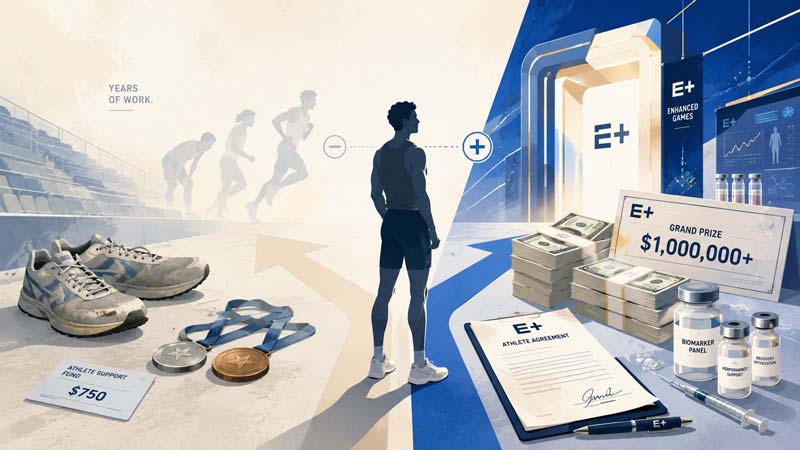
The gap itself is the argument. A world swimming title pays the winner around $20,000. A single win at this event pays $250,000. Ben Proud, an Olympic silver medallist, put the maths plainly.
It would have taken me 13 years of winning a World Championship title to win what I could win in a single race here.
Thirteen years of winning, against one single race. The American swimmer Cody Miller was just as blunt, saying the money here beat Olympic pay, and not narrowly.
I understand this ground from the inside. I left education at thirty-two, still chasing the athlete’s dream. When I stopped, my friends owned homes and settled lives. I owned a dream that never paid a penny. I have been catching up ever since.
So I feel for these competitors. Most are not wealthy. A British athlete on lottery funding might see £28,000 in a strong year. Many countries pay their athletes nothing at all. Affection arrives with the medals, and affection does not pay a mortgage.
Nobody is forced, they say
The organisers insist that nobody is forced to dope. The athletes echo the line. I find that claim very hard to take seriously. An organisation chasing world records will not parade an athlete who stays natural and finishes last. The incentive points one way only.
Reece Prescod, a British Olympic sprinter, shows how this works. He first told reporters he would not take the drugs. Months later, his position had quietly moved.
If that’s something that will take me to the next level, I’m not against it.
That drift was easy to predict because the Enhanced Games contract and the prize money quietly demand it. The choice exists on paper. The pressure exists everywhere else.
One more thing about these athletes deserves notice. They are not teenagers in their prime. They are people near the end, watching the door close. Their fastest times already sit behind them. An older body is now reaching back for a younger body’s record.
Doping in Sport Is Nothing New
Drugs did not arrive with this event. They have lived inside sport for forty years, hiding in plain sight.
It goes back to Seoul in 1988. Ben Johnson won the Olympic 100 metres, then lost it to a failed test. That was not the beginning of doping. It was simply the public being shown.
Testing only catches the careless
Anti-doping can only find what it already knows to look for. The BALCO scandal proved it cold. A designer steroid called THG stayed invisible for years. It had been built, on purpose, to slip past the tests. It surfaced only when a rival coach handed investigators the recipe. Suddenly, the retests caught household names.
That tells you something blunt. The athletes who get caught are rarely the worst cheats. They are the careless ones, or the unlucky ones.
Two numbers sit side by side awkwardly. At the 2011 World Athletics Championships, an anonymous survey gave a stark figure. Almost 44% of athletes admitted to using a banned substance that year. A separate British study put knowing drug use near 13%. Yet across a full year of testing, only a tiny fraction of samples ever fail.
That gap is the real headline. A system catching a sliver, while surveys show a flood, is not a deterrent. It is a lottery. Even David Howman, a former head of the World Anti-Doping Agency, has admitted the system stalled. The level playing field was always partly a story we agreed to tell.
I have collected the most prominent cases since 1988 in the table below. It rewards a slow read. You will know the sprinters, the cyclists, the swimmers, the baseball and boxing names. Two columns deserve a hard look: their status and their reported health. The Enhanced Games did not invent doping. It only switched the lights on.
Prominent Doping Cases in Elite Sport Since 1988
Abbreviations: THG = tetrahydrogestrinone (a designer steroid). EPO = erythropoietin. ABP = Athlete Biological Passport. CAS = Court of Arbitration for Sport. PED = performance-enhancing drug.
A reference timeline of well-known performance-enhancing drug cases in elite sport since the 1988 Seoul Olympics. It places the Enhanced Games in its proper historical context, a reminder that the argument over drugs in sport stretches back decades before this event ever existed.
The table cuts in two directions, and honesty means owning both. There is no proof that the Enhanced Games have made doping safe. Marco Pantani is on it, a Tour de France champion brought down by a doping scandal. He was dead at thirty-four, though the drugs were not blamed for that. A ruined career is its own heavy cost.
Yet most of the other names are still here, living ordinary lives. Bodybuilders have used these same drugs for decades, and the gyms are not full of ghosts. The honest reading sits between panic and applause, and almost nobody wants to stand there.
Are the Enhanced Games Actually Dangerous?
Now the hard question, and it deserves a straight answer. Are the people competing actually risking their lives?
The experts who study this are blunt. They warn of heart attacks, strokes, and lasting damage to mood and mind. One researcher noted that some effects on the brain may never reverse. These are not small-print risks.
The athletes answer with their own bodies. James Magnussen, an Australian swimmer, doped hard and tracked every reading.
If there were to be a long-term effect, surely there would be some sign in the short to medium term. We did not experience that at all.
The organisers of the Enhanced Games lean on supervision. They promise hospital monitoring and yearly checks for five years. Their chief executive compared the risk to ordinary life, noting that aspirin kills people every year.
Neither side can be fully right. So how should a fair person weigh it?
The question sport will not ask itself.
One researcher made a point that lodged in my head. Society already accepts terrible harm for entertainment. Boxing trades in brain damage, and we watch it on a Saturday night. So Enhanced Games has not crossed any clear moral line. It has slid a little further along a line we crossed long ago. The outrage may be sincere, but it is not consistent.
The contradiction nobody wants to name
Here the argument turns, and it turns sharply. Sport’s authorities say that altering a healthy body with drugs is dangerous and wrong. Yet those same authorities have ordered exactly that. World Athletics has required certain women to lower their natural testosterone with medication. These are athletes born female, with naturally high levels.
The two cases sit oddly together. One healthy body is told that drugs are far too dangerous to touch. Another healthy body is told to take drugs to stay eligible. Adding a hormone and forcing one down are the same act. Both reach into a healthy body and change it.
I explored the genetics and the ethics of that hormone question in my post on transgender athletes in sport. It is this argument wearing different clothes. If chemical interference is the danger, then chemical interference cannot also be the cure.
The Part That Should Worry Us All
Forget Las Vegas for a moment. Forget the athletes and the prize pot. The danger that should hold your attention is far closer to home.
It is on your child’s phone.
TikTok and YouTube are full of young men injecting drugs on camera. Many are barely adults, and they show it with pride. They call it looksmaxxing, the chase to look as good as possible. Young women are doing it too, because a harder body earns more as an influencer.
The contrast with the athletes in Abu Dhabi is the entire point.
The competitor in the resort has a hospital, blood panels and a five-year follow-up. The teenager copying him has a parcel from a stranger and a guess. Same drugs, wildly different safety net. When the Enhanced Games say supervision makes this safe, it quietly proves the opposite. Strip away the supervision, and only the risk remains.
The retired sprinter Iwan Thomas named the fear precisely.
The more we see of this, the more normalised drug-taking becomes. Joe Bloggs on the street will think, ‘I can make a load of money if I take drugs.’
That word, normalised, carries the real weight. And here, a quieter shift makes it worse. The older generation of users hid their needles in shame. The younger one films the needle and posts it for applause. Shame once slowed this down. Shame has now gone.
The endpoint is clear. Enhanced Games sells enhancements as glamorous, monitored, and lucrative. Its organisers have openly said they want to sell these same drugs to the public. The event is the advert. The website will be the shop. We already watch young bodybuilders die chasing this look, and they had no resort and no doctor.
My Final Word on the Enhanced Games
So where do I land? Honestly, in two places at once, and I will not pretend otherwise.
On traditional sport, I have not moved an inch. Drugs there are a betrayal. I watched clean friends lose to cheats who were never caught, then watched them lose their livelihoods too. That is not a level field. It is a slow robbery.
But this contest is not a traditional sport, and that distinction earns more respect than critics give it. Kirsty Coventry, who leads the International Olympic Committee, said it well. Different competitions follow different rules, and they are free to do so. The Olympics keep its lane. This event runs in another. Two lanes, not one race.
Seen that way, my anger cools into curiosity. And that curiosity has a sharp edge.
What the results will actually mean
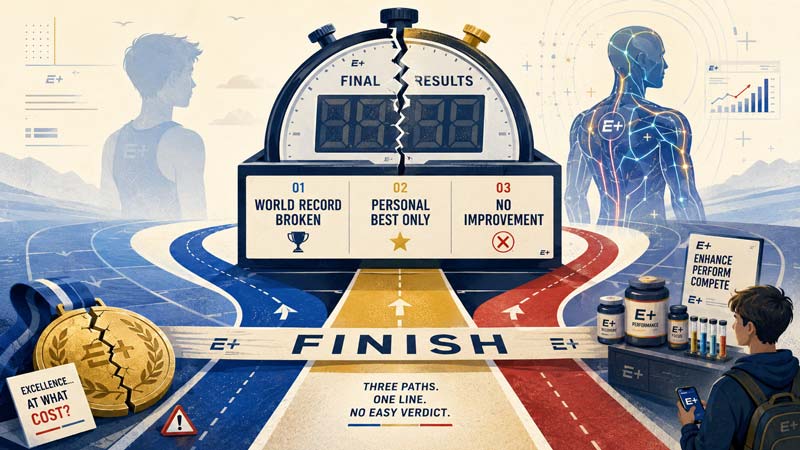
The athletes competing share one quiet, important fact. They are older now than when they set their personal bests. So we are about to watch an older, fully doped, monitored body chase a younger, supposedly clean one. That is a real experiment.
Three outcomes are possible, and each one says something loud.
- They break world records: Then drugs are a powerful accelerant, and that is worth knowing plainly.
- They beat their own younger times, but miss the records: Then drugs help, yet youth and rare talent still rule.
- They cannot even reach their younger bests: Either these drugs do far less than promised, or that younger self was never clean.
Why drugs alone never tell the whole story
There is one more layer, and Lance Armstrong explains it best. Armstrong was a freak of nature long before he doped. In a sport where every rival doped too, his own doping only held a gap that already existed. That is the part people miss. Drugs lift the entire field at once. They rarely close the distance between a special talent and the pack.
So a world record needs rare genetics and chemistry together. Chemistry on its own has never been enough. The Enhanced Games are therefore not only testing drugs. It is testing how much of greatness was ever chemical at all.
That is the strange gift buried in this loud, vulgar event. It is an experiment running in daylight, and I will be watching every heat.
Still, I cannot give it a clean pass. The Enhanced Games also works as a shopfront, selling drugs to ordinary people who get no resort and no doctor. The competitor accepted that risk with their eyes open. The teenager copying him did not.
So I will not tell you what to think. I have shown you the money, the science, the history and the people, and reasoned through them honestly. The lights are on in Las Vegas. What you carry away from them is now yours.
Sources
- BBC Sport. Enhanced Games: A Sporting Revolution or Dangerous Doping? | Full Documentary | BBC Sport. 9 March 2026. YouTube.
- The wild sporting experiment where drugs are encouraged. 15 April 2026. YouTube.
- Dan Roan. Enhanced Games is finally here – causing dismay and intrigue. 20 May 2026. BBC
- ITV News. Inside the most controversial sport in history: Dangerous or the future? 6 February 2026. YouTube.
- Mike Henson. Enhanced Games swimmer ‘breaks world record’. 21 May 2025. BBC